Blanche Monnier: The Woman Hidden for 25 Years Locked away by her own family in plain sight
Updated: Feb 11
A Celebrated Beauty Who Vanished
In the late 1800s, Blanche Monnier was well known in French high society. Born in 1849, she came from a wealthy and respected family in Poitiers, France. Blanche was described as intelligent, kind, and strikingly beautiful. She attended social events, was admired in aristocratic circles, and was once considered a desirable match.
Then, suddenly, she disappeared.
No missing persons report was filed. No public concern followed. Among the upper class, her absence was quietly explained away. Some believed she had withdrawn from society. Others assumed she had left to live a private life. In a world where reputation mattered more than questions, no one pressed further.
For the next 25 years, Blanche Monnier was never seen again.
The Love Her Family Refused to Accept
In 1877, Blanche fell in love with a man her mother, Louise Monnier, strongly disapproved of. He was older, Protestant, politically liberal, and considered socially unsuitable. To Louise, the relationship threatened the family’s image and status.
Blanche refused to give him up.
Rather than allow her daughter to marry the man she loved, Louise made a decision that would remain hidden for decades. Blanche was locked inside a small room in the family home. The shutters were closed. The door was sealed. Blanche was cut off from the outside world.
She was 27 years old.
A Life Reduced to Darkness
For the next quarter century, Blanche lived in total isolation. She was kept in a dark, shuttered room with no sunlight and no fresh air. She slept on a straw mattress. Food, when given, was often scraps. Waste accumulated. Insects infested the space.
Blanche was not allowed to leave the room.
Outside those walls, life went on. Louise Monnier continued to move freely in society. The family maintained their reputation. Neighbors, servants, and officials either did not notice or chose not to question what was happening inside the home.
Blanche existed without movement, without light, and without a voice.
The Anonymous Letter That Changed Everything
In May 1901, the Paris public prosecutor received an anonymous letter. It claimed that an unmarried woman had been imprisoned for decades in the Monnier household.
Police went to investigate.
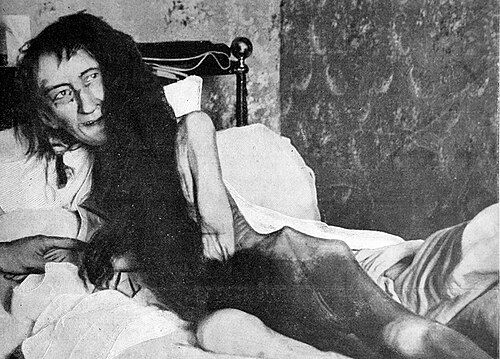
When officers forced open the sealed room, they found a scene that shocked even seasoned investigators. Blanche Monnier, now 52 years old, was lying naked on a straw mattress. She was severely malnourished, skeletal, and covered in filth. The room was filled with rotting food, bones, insects, and years of accumulated waste.
She weighed approximately 55 pounds.
Blanche had not seen sunlight in 25 years.
Public Horror and National Outrage
News of the discovery spread rapidly across France. The public reaction was immediate and intense. Newspapers detailed the conditions of Blanche’s imprisonment, and the case horrified a nation that prided itself on culture and civility.
Thousands of Parisians gathered outside the courthouse when Louise Monnier was arrested. Reports from the time describe crowds cheering as news of her arrest broke. The case forced France to confront an uncomfortable truth: cruelty could exist behind wealth, respectability, and closed doors.
The abuse was not hidden in poverty or chaos. It was hidden in privilege.
The Legal Aftermath
Louise Monnier was arrested shortly after Blanche’s rescue, but she never faced trial. She died in prison just 15 days later.
Blanche’s brother, Marcel Monnier, was also charged. He was initially convicted but later had his sentence overturned. The court ruled that under French law at the time, failing to rescue someone did not constitute the same level of criminal responsibility as direct physical abuse.
This legal outcome sparked further outrage and later influenced discussions around duty to rescue laws in France.
Blanche Monnier's Final Years
After her rescue, Blanche was placed in a psychiatric hospital. Despite being physically freed, the damage from decades of isolation could not be undone. She struggled to adjust to normal life and never fully recovered.
Blanche Monnier died in 1913, twelve years after her release.
She was 64 years old.
Why This Case Still Matters
The Blanche Monnier case remains one of the most disturbing examples of abuse hidden behind social status. For 25 years, an entire system failed her. Family loyalty, societal deference, and the power of reputation all worked together to keep her suffering invisible.
Her story is not just about one woman locked in a room. It is about how easily silence can protect cruelty, and how long injustice can persist when no one is willing to ask questions.
Blanche Monnier was not lost.
She was hidden.
Case Facts
Location: Poitiers, France
Year: 1876 (imprisonment began); 1901 (discovery and rescue)
Victim: Blanche Monnier, age 25 at the time she was confined
Responsible Person: Louise Monnier (her mother) and Marcel Monnier (her brother)
Outcome: Blanche Monnier was secretly locked in a small, dark room by her family after she wished to marry a man they disapproved of. She was kept there for approximately 25 years in extreme neglect, receiving little food and living among filth. In May 1901, authorities discovered her after an anonymous letter alerted police. Blanche was severely malnourished and mentally traumatized. Her mother was arrested but died shortly after her release from custody due to illness. Her brother was convicted but later acquitted on appeal. Blanche spent the rest of her life in a psychiatric hospital and never fully recovered.
Read Next:


Comments